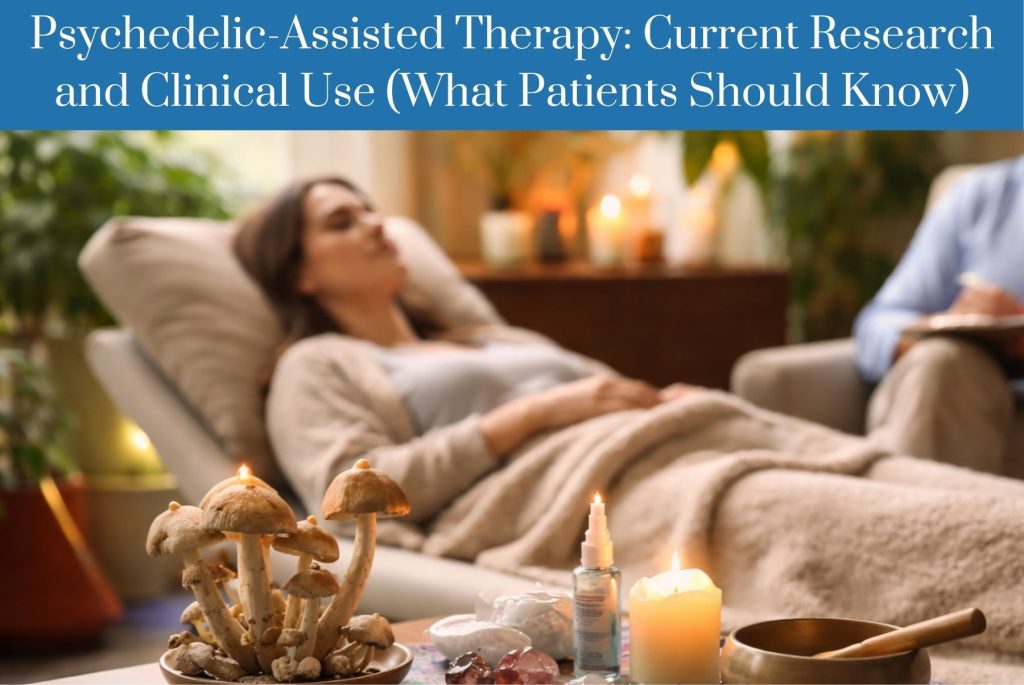
Interest in psychedelic-assisted therapy has surged in recent years—driven by promising research in conditions like depression, PTSD, anxiety, and addiction. At the same time, the clinical reality is nuanced: some treatments are legally available now in medical settings, while others remain limited to regulated research studies.
Below is a clear, evidence-informed overview of where the science stands today, what “psychedelic-assisted therapy” actually means in practice, and how to think about safety, eligibility, and next steps.
What is psychedelic-assisted therapy?
Psychedelic-assisted therapy generally refers to a structured clinical approach that combines:
- Carefully supervised medication sessions (with a psychoactive compound), and
- Psychotherapy support before and after (preparation and “integration” sessions)
Research consistently emphasizes set and setting—the patient’s mindset, medical/psychological screening, therapeutic support, and the physical environment—as key factors influencing outcomes. BrainFutures+1
The current clinical landscape: what’s available now vs. what’s still in research
1) What’s currently legal in U.S. medical settings
Ketamine and esketamine (Spravato®) are the most established “psychedelic-adjacent” treatments currently used in clinical practice for depression.
- Esketamine (Spravato®) is FDA-approved and delivered as a nasal spray under a safety program (REMS) in certified settings. The FDA originally approved Spravato for treatment-resistant depression in conjunction with an oral antidepressant. U.S. Food and Drug Administration
- The FDA has expanded Spravato’s approval, allowing broader use (including standalone use for major depressive disorder in certain contexts), increasing clinician flexibility in treatment planning. Reuters+1
Ketamine (racemic ketamine) is also used off-label in some clinics for depression and other conditions, typically as IV infusions, IM injections, or lozenges—often paired with psychotherapy support models in some practices. Evidence and protocols vary, so careful medical oversight matters. Frontiers+1
2) Therapies still primarily limited to clinical trials (as of now)
MDMA-assisted therapy for PTSD and psilocybin-assisted therapy are two of the most studied investigational approaches, but they are not broadly available as standard medical care in the U.S.
- In August 2024, the FDA declined approval of MDMA-assisted therapy for PTSD (a major setback for near-term access outside of trials). Association of Health Care Journalists+2ScienceAlert+2
- Psilocybin research is advancing, including late-stage development programs and registered clinical trials evaluating safety and efficacy for depression and related conditions. ClinicalTrials.gov+1
What a “medication session” typically looks like (in research and specialty care models)
While protocols differ by substance and study site, many programs include:
- Medical + psychiatric screening (history, medications, contraindications, safety planning)
- Preparation sessions to set goals, build coping tools, and reduce anxiety
- Supervised dosing session in a controlled therapeutic environment
- Integration therapy afterward to process insights, emotions, and behavior change
This structure is not just “nice to have”—it’s a major part of why outcomes in clinical studies can differ from unsupervised or recreational use. BrainFutures+1
Potential benefits being studied (and why the interest is so strong)
Research teams are investigating whether psychedelic-assisted approaches may help some patients:
- Reduce symptoms faster than conventional treatments
- Increase psychological flexibility and emotional processing
- Improve engagement in psychotherapy (especially for trauma-related work)
- Provide durable symptom relief for some people after only one or a few sessions
That said, results vary. Psychedelic experiences can be intense, and not everyone is an appropriate candidate.
Safety, risks, and why medical screening is essential
Psychedelic-assisted therapy is not risk-free. Potential concerns can include:
- Acute anxiety or panic, distressing experiences, or worsening symptoms
- Increases in blood pressure/heart rate (depending on the substance)
- Medication interactions (including with some psychiatric meds)
- Risk in people with certain histories (for example, mania or psychosis vulnerability)
- Need for follow-up support if difficult material surfaces
A reputable clinical approach prioritizes screening, informed consent, emergency planning, and integration support. BrainFutures+1
Frequently Asked Questions (Comprehensive Q&A)
1) Is psychedelic-assisted therapy legal in California?
It depends on the substance and setting. FDA-approved treatments like esketamine (Spravato®) can be provided in certified medical settings. Many other psychedelics (e.g., psilocybin, MDMA) are generally not available as standard care and are often limited to regulated research trials. U.S. Food and Drug Administration+1
2) What conditions are being researched the most?
Common research targets include PTSD, major depression, treatment-resistant depression, anxiety (including in serious illness), and substance use disorders—with especially strong attention on PTSD (MDMA) and depression (psilocybin and ketamine/esketamine). Association of Health Care Journalists+2ClinicalTrials.gov+2
3) What’s the difference between ketamine and classic psychedelics like psilocybin?
Ketamine is a dissociative anesthetic with antidepressant effects; psilocybin is a classic serotonergic psychedelic. Their mechanisms, subjective experiences, dosing sessions, and evidence bases differ. Esketamine (Spravato®) is a ketamine-derived medication specifically regulated for clinical use. U.S. Food and Drug Administration+2Reuters+2
4) Is MDMA-assisted therapy FDA-approved?
Not at this time. The FDA declined approval in August 2024, so access is not broadly available outside approved research pathways. Association of Health Care Journalists+1
5) Is psilocybin therapy FDA-approved?
Not currently. Psilocybin remains investigational at the federal level, though multiple clinical trials are underway. ClinicalTrials.gov+1
6) What does “integration” mean, and why is it important?
Integration is the psychotherapy process after a dosing session that helps translate insights into real-world behavior change—coping skills, relationship patterns, trauma processing, and healthier habits. Many practice guidelines and clinical discussions treat integration as a core component, not an optional add-on. BrainFutures+1
7) Who might not be a good candidate?
This is individualized, but clinicians often screen carefully for:
- Certain cardiovascular risks (for some protocols)
- History of mania/psychosis or strong vulnerability
- Unstable substance use or unsafe home environment without support
- Medication conflicts that may require careful coordination
A formal evaluation is the right starting point. BrainFutures+1
8) What does a typical treatment timeline look like?
Many models include:
- 1–3+ preparation sessions
- 1+ supervised medication sessions
- Several integration sessions afterward
Exact timing varies by condition, medication, and clinical protocol. BrainFutures+1
9) Are the effects permanent?
Not necessarily. Some people experience meaningful, durable benefit; others need ongoing treatment, booster sessions, or a combined plan with therapy/medications. The goal is sustained improvement—not a single “miracle session.”
10) Is it safe to try psychedelics on my own to “self-treat”?
Self-treatment carries real risks: unknown dosing/purity, lack of screening, unsafe psychological reactions, and lack of integration support. Clinical models exist specifically to reduce these risks and to support lasting change. BrainFutures+1
11) How do I find legitimate clinical trials?
A good starting place is ClinicalTrials.gov, which lists active studies, inclusion criteria, and contact information for recruiting sites. ClinicalTrials.gov
12) What questions should I ask any clinic offering ketamine/esketamine care?
Consider asking:
- What screening do you require (medical + psychiatric)?
- Who is present during sessions, and what training do they have?
- What monitoring and emergency protocols are used?
- How is integration therapy handled?
- What outcomes do you track over time?
- What is the full cost, and does insurance apply (especially for Spravato)? U.S. Food and Drug Administration+1
A practical takeaway
Psychedelic-assisted therapy is an evolving field with genuine promise—and real complexity. If you’re curious, the safest next step is a professional evaluation with a clinician who can review your history, explain evidence-based options (including currently available treatments like esketamine), and help you decide whether a trial or treatment program is appropriate.
Contact Information
Matthew Goldenberg D.O.
2708 Wilshire Blvd
Santa Monica, CA 90403
Phone: (424) 276-0777
Book An Appointment / Website: docgoldenberg.com
Meta Title:
Meta Description: