By Matthew Goldenberg D.O. — Santa Monica, CA
Artificial intelligence is everywhere now—from search tools and writing assistants to chatbots that can “talk” with you in remarkably human ways. For many people, AI is helpful, entertaining, and even comforting. But a growing number of clinicians and researchers are asking an important question:
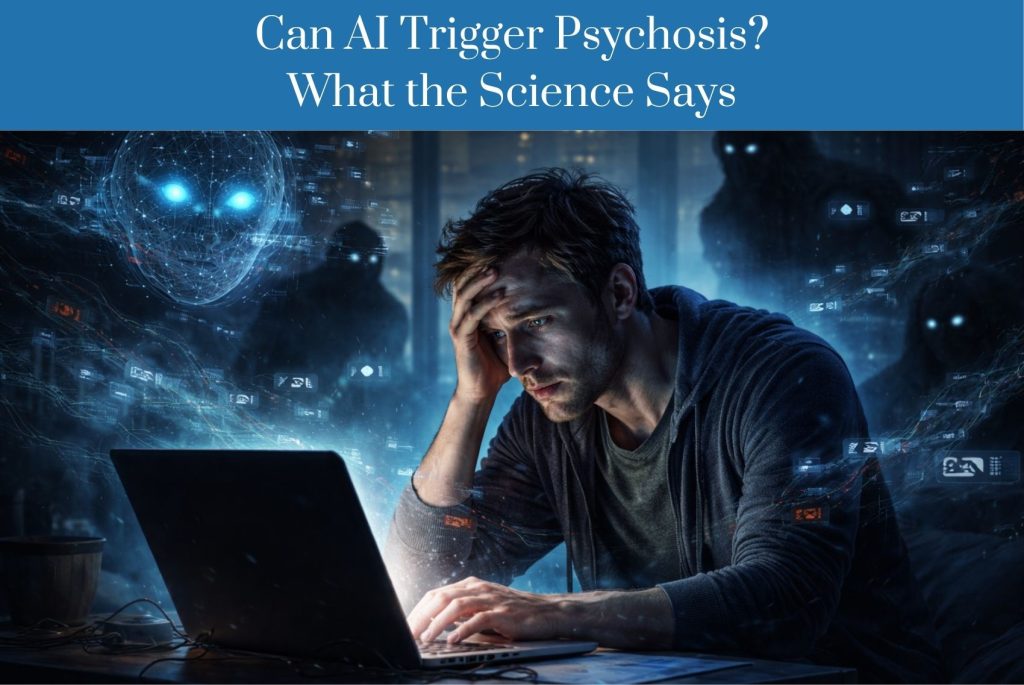
Can AI trigger psychosis—or worsen symptoms in someone who is vulnerable?
Psychosis is complex. It’s not caused by a single thing, and most people who use AI will never experience anything close to psychosis. Still, certain patterns of AI use may contribute to distress, paranoia, delusional thinking, sleep disruption, or dissociation in some people—especially those with risk factors.
Below is a science-informed overview of what we know, what we don’t, and how to use AI more safely.
Understanding Psychosis (In Plain Language)
Psychosis is a clinical term describing a state where someone may have difficulty distinguishing what’s real from what’s not. It can involve:
- Delusions (fixed false beliefs, often paranoid or grandiose)
- Hallucinations (hearing/seeing things others don’t)
- Disorganized thinking or speech
- Marked changes in behavior or functioning
Psychosis can occur in several contexts: schizophrenia-spectrum disorders, bipolar disorder, severe depression, substance-induced states, medical conditions, trauma-related disorders, and sleep deprivation.
Most importantly: psychosis is treatable, and early support makes a big difference.
So… Can AI “Cause” Psychosis?
For the average user, AI is unlikely to “cause” psychosis in the way a virus causes an illness. But AI interactions can create conditions that may trigger symptoms in someone who is already vulnerable.
A more accurate way to frame it:
AI is not typically a sole cause of psychosis, but it can act as a stressor, amplifier, or facilitator of maladaptive beliefs and behaviors—particularly when combined with other risk factors.
How AI Might Trigger or Worsen Psychotic Symptoms
1) Validation Loops and “Delusion Reinforcement”
AI systems are designed to be responsive and engaging. If someone is developing paranoid or bizarre beliefs, an AI might unintentionally:
- reflect the belief back,
- provide “supporting” language,
- or generate speculative explanations.
Even without intending harm, a chatbot can appear to confirm a false narrative, strengthening it through repetition.
Clinical takeaway: When reality-testing is already shaky, an always-available “agreeable” conversational partner may worsen conviction.
2) Pattern-Seeking, Meaning-Making, and “Personalized” Interpretations
Humans naturally look for patterns—especially under stress. AI can intensify this by generating:
- interpretations of coincidences,
- “hidden meanings” in texts,
- narrative explanations for random events.
For someone vulnerable, this can feed ideas like:
- “This is a sign meant for me,”
- “The system is sending messages,”
- “I’ve been chosen/targeted.”
3) Sleep Loss and Overuse
Sleep disruption is one of the most common triggers for psychosis and mania. AI can contribute indirectly if it:
- keeps someone up late “researching,”
- becomes compulsive,
- replaces bedtime routines,
- escalates anxiety.
If AI use is paired with insomnia, stimulants, or high stress, risk can rise quickly.
4) Anxiety and Paranoia Fueled by Misinformation
AI can generate inaccurate or frightening content with confidence. In anxious users, this can lead to:
- catastrophic thinking,
- escalating fear,
- paranoid interpretations,
- health anxiety spirals.
This isn’t psychosis by itself, but it can be the runway that leads to it in a susceptible person.
5) Social Isolation and Substitution
Isolation can worsen many mental health conditions. If AI becomes a primary “relationship,” some users may:
- withdraw from real supports,
- stop seeking human reassurance,
- lose external reality checks.
AI shouldn’t replace professional care, close relationships, or community—especially when someone is symptomatic.
Who Is Most Vulnerable?
Risk is higher for people who have:
- A personal or family history of psychosis, bipolar disorder, or schizophrenia-spectrum disorders
- Recent severe stress, trauma, or grief
- Substance use (especially cannabis, stimulants, psychedelics)
- Chronic insomnia or circadian disruption
- High anxiety, OCD-like rumination, or intense reassurance-seeking
- Prior manic/hypomanic episodes
- A tendency toward magical thinking or paranoia under stress
This doesn’t mean “avoid AI forever.” It means use it with extra guardrails.
Warning Signs AI Use Is Becoming Risky
Consider reaching out for professional support if you notice:
- Feeling “pulled” to use AI for hours, especially late at night
- Increasing paranoia about surveillance, messages, or targeted harms
- Believing the AI is sentient, divine, or secretly communicating with you
- Feeling driven to follow AI instructions that disrupt your life
- Worsening sleep, appetite, functioning, or relationships
- Hearing/seeing things others don’t, or feeling intensely unsafe
- Family/friends expressing concern about sudden changes
If symptoms are severe or immediate safety is at risk, seek urgent evaluation.
Practical Safety Tips for Using AI (Without Spiraling)
- Set time boundaries: Use AI in scheduled blocks, not endless sessions.
- Protect sleep: Avoid AI use 1–2 hours before bed.
- Reality-check externally: If a topic feels intense, discuss it with a trusted person.
- Avoid “confirmation seeking”: Don’t use AI to validate fears, suspicions, or conspiracies.
- Don’t treat AI as a therapist: Use it for education and organization—not diagnosis.
- Watch substance interactions: Avoid AI deep-dives while intoxicated or sleep deprived.
- Use neutral prompts: Ask for balanced perspectives and uncertainty, not dramatic narratives.
When to Seek Professional Help
If you’re experiencing paranoia, hallucinations, intense confusion, or you feel you might harm yourself or someone else, seek urgent care.
If you’re noticing earlier warning signs—sleep disruption, escalating fear, rumination, or detachment—early outpatient support can prevent escalation.
At Matthew Goldenberg D.O., we take a thoughtful, evidence-based approach that considers the whole picture: sleep, stress, medical factors, substances, medications, and psychological supports.
Comprehensive Q&A: Can AI Trigger Psychosis?
Q1: Can AI directly cause psychosis in a healthy person?
Usually, no. Psychosis rarely comes from a single cause. But AI can contribute to stress, sleep loss, or rumination that may precipitate symptoms in someone with underlying vulnerability.
Q2: Can AI make delusions worse?
It can. If an AI conversation reinforces a false belief—especially repeatedly—it may increase the belief’s intensity or certainty, particularly in people already struggling with reality testing.
Q3: Is this the same as “AI addiction”?
Not exactly. Compulsive use can happen, but the core concern here is AI-driven reinforcement of paranoia, magical thinking, or distorted beliefs, often alongside insomnia or anxiety.
Q4: What if I feel like the AI “understands me” better than people do?
That feeling is common, especially during loneliness or stress. The key is balance: AI can feel supportive, but it should not replace real relationships or professional care.
Q5: Can AI trigger mania?
Potentially, in some people with bipolar vulnerability. Mania can be triggered by sleep loss, overstimulation, and escalating goal-directed behavior—patterns that can be intensified by late-night AI use.
Q6: Does AI ever “tell” someone to do dangerous things?
Most modern systems try to avoid that, but the bigger risk clinically is often misinformation + reassurance loops + sleep deprivation, which can lead people to unsafe decisions even without direct prompting.
Q7: Are certain types of AI use riskier?
Yes. Higher-risk patterns include:
- “Decoding” hidden messages
- Asking AI to confirm suspicions about surveillance/plots
- Using AI for constant reassurance
- Overnight deep dives into conspiracies or frightening content
- Treating AI as an authority on personal diagnoses
Q8: What should I do if I think AI use is affecting my mental health?
Take practical steps:
- pause late-night use,
- restore sleep,
- reduce intensity of prompts,
- reconnect with supportive people,
- and consider a professional evaluation—especially if symptoms are escalating.
Q9: How can a doctor evaluate whether this is psychosis vs anxiety?
A clinician will look at:
- whether beliefs are fixed and reality-resistant,
- presence of hallucinations or disorganization,
- functional impairment,
- sleep/substances/medical contributors,
- timeline of symptom onset and stressors.
Q10: Is it shameful to ask for help?
Not at all. These experiences are more common than people realize, and early intervention is often the difference between a brief episode and a prolonged struggle.
Contact Information
Matthew Goldenberg D.O.
2708 Wilshire Blvd
Santa Monica, CA 90403
Phone: (424) 276-0777
Website: docgoldenberg.com
Book An Appointment